Product case study: Designing an AI-powered opportunity discovery platform for a global fintech firm
A global fintech firm's business development team was spending hundreds of hours manually discovering cross-border business opportunities. Their process relied entirely on human analysts monitoring market intelligence platforms like S&P Global, IHS Markit, FactSet, and Bloomberg, manually scanning financial news, M&A activity, regulatory changes, and corporate restructurings across every major financial center in the world.
I was brought in as the Product Strategist and Designer to design a platform where AI agents would replace this manual research, automatically discovering, structuring, and presenting global opportunities, and then enabling marketers to act on them through AI-assisted outreach.
The result: a multi-agent system that reduced manual research efforts by 95%, improved outreach efficiency by 80%, and boosted client engagement rates by 40%.
Product strategy Product design AI workflow definition User journey mapping Interaction design Development Coordination
1 x Product Strategist (me) 1 x Product Designer (me) Development team (post-handoff)
2024
Problem Framing: The client's team was manually monitoring dozens of global market intelligence sources to identify cross-border opportunities: M&A deals, corporate restructurings, regulatory shifts, new market entries, and tax advisory triggers. Each opportunity required deep secondary research before outreach could begin. The entire pipeline from discovery to first email could take weeks.
AI Agent Architecture: We designed a multi-agent system with distinct responsibilities. Agent 1 (Discovery) continuously monitors market intelligence sources and generates structured opportunity data for every major financial center. Agent 2 (Research) performs deep secondary research on specific opportunities, including company profiles, decision-maker identification, recent acquisitions, financial trends, and competitive positioning. A third agent for in-app navigation was prototyped but deprioritized given the maturity of agentic capabilities in late 2024.
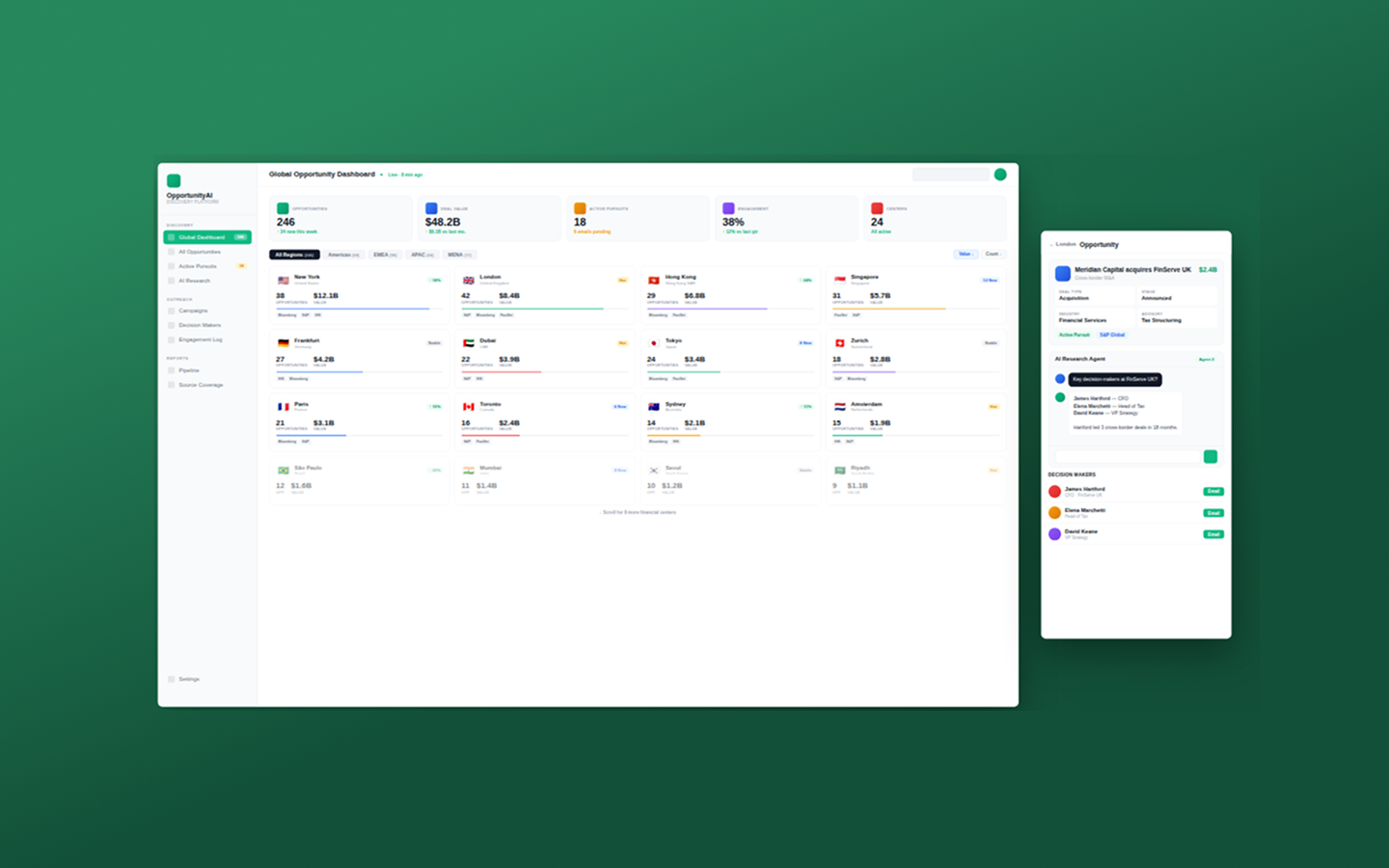
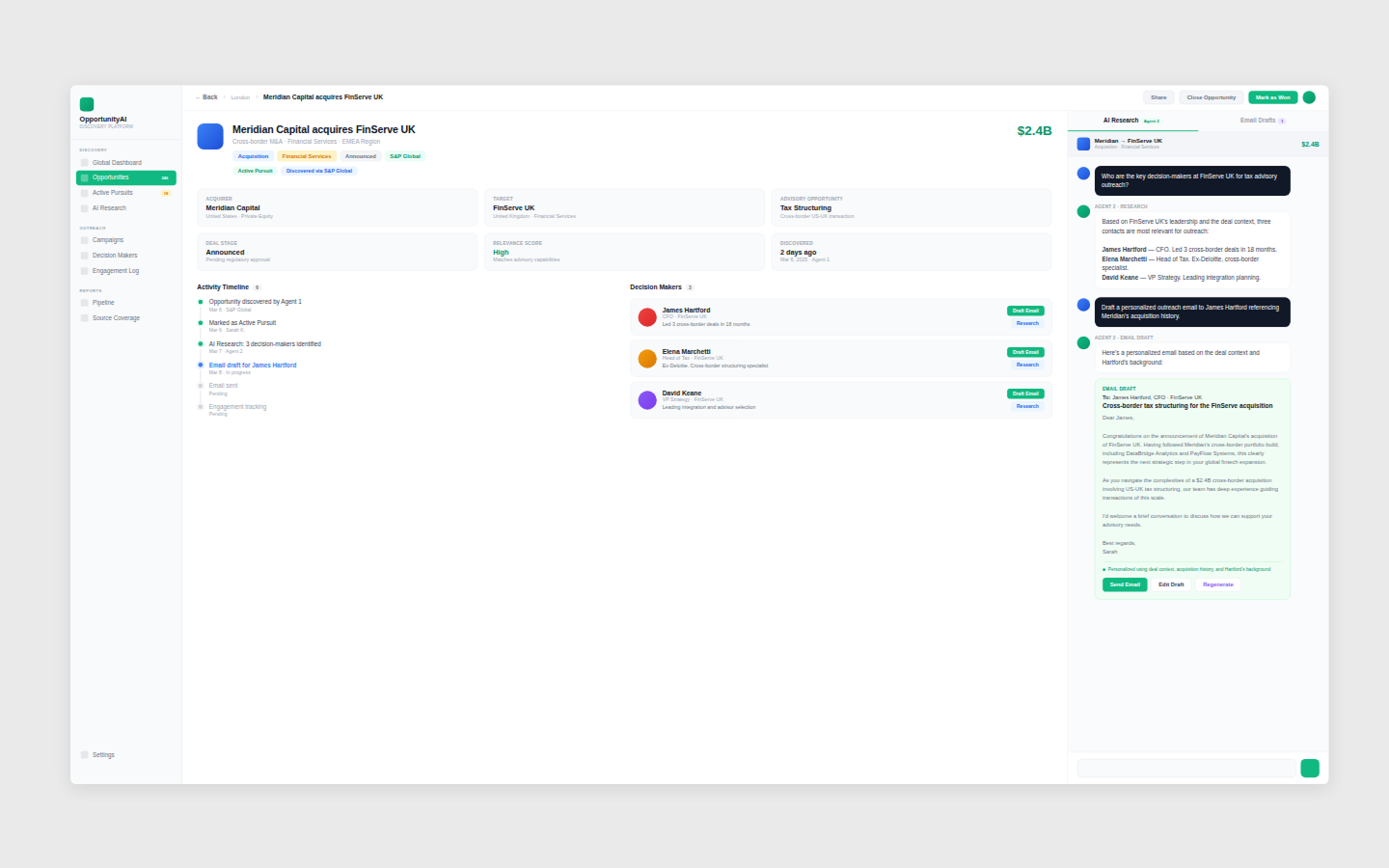
Information Architecture: I structured the platform around the marketer's workflow: global view → regional filter → opportunity detail → secondary research → targeted outreach. Each level progressively narrows focus while increasing depth.
Interaction Design: Designed the opportunity discovery interface with country-level segmentation, multi-dimensional filtering (opportunity value, volume, source platform, deal type, industry sector, geographic region), and status management (open, closed, active, inactive, email sent) to enable grouping and tracking of outreach conversations.
Secondary Research & Outreach: Each opportunity has a dedicated AI-powered research panel where the marketer can query Agent 2 for company-specific intelligence, and then use the insights to generate highly targeted email copy for shortlisted decision-makers, all within the same interface.

95% reduction in manual research efforts (from all-manual monitoring to AI-automated discovery)
80% improvement in outreach efficiency (from manual research-to-email to AI-assisted pipeline)
40% boost in client engagement rates
Follow-on engagement: Based on outcomes, the client commissioned a second product (currently in development) using multiple parallel agents to automate account management and service delivery workflows.
KEY DECISIONS & TRADE-OFFS:
Why structure around financial centers, not deal types?
The client's team thinks geographically. Their coverage is organized by region, not by transaction category. Structuring the interface around financial centers matched their mental model and made adoption frictionless.
Why two agents instead of one?
Discovery and deep research are fundamentally different tasks. The discovery agent needs breadth (scanning thousands of sources continuously). The research agent needs depth (deep-diving into a single company). Separating them allowed each to be optimized for its specific task.
Why we killed the third agen?
We prototyped an in-app navigation agent that would help users find specific conversations and data within the platform. In late 2024, agentic capabilities were not mature enough to deliver this reliably. Rather than shipping something unpredictable, we deprioritized it to keep the core workflow practical and trustworthy.
Why status management matters in an AI system?
AI generates opportunities at scale. Without status tracking (open, closed, active, inactive, email sent), the marketer would drown in unstructured data. The status system converted AI output from noise into a manageable pipeline.

.svg)
